About Us
International Society for Krishna Consciousness (ISKCON)
What is ISKCON, better known worldwide as the Krishna Consciousness or Hare Krishna movement? ISKCON belongs to the Gaudiya-Vaishnava-Sampradaya – one of the four main schools of Vaishnavism, considered a monotheistic religion of Vedic or Hindu culture. The religious-philosophical doctrine of this school is based on the principles formulated in the historic Sanskrit scriptures of Vedic culture – the Bhagavad-Gita and Srimad Bhagavatam (Bhagavata Purana). These scriptures reveal the main goal of human life – the restoration of a loving relationship with the Lord – the tradition of Bhakti Yoga.
In various cultures, the Lord is called by different names: Allah, Buddha, Yahweh, Vishnu, Krishna, Rama, etc. These are like different clothes worn by the same Personality – God – under different circumstances. ISKCON devotees glorify God's names by chanting the maha-mantra, the great song of deliverance:
Hare Krishna, Hare Krishna, Krishna Krishna, Hare Hare Hare Rama, Hare Rama, Rama Rama, Hare Hare.
Here Krishna and Rama are names of the Lord, indicating the All-Attractive and the Source of All Pleasure, and Hara is the energy of the Lord, which becomes Hare in the vocative case. In other words, it is an address to the Lord and His energy, asking for permission and mercy to serve Him. By glorifying the Lord and serving Him, the adept cleanses the accumulated dirt from the heart, discovers their true "self" and their true nature.
Srila Prabhupada
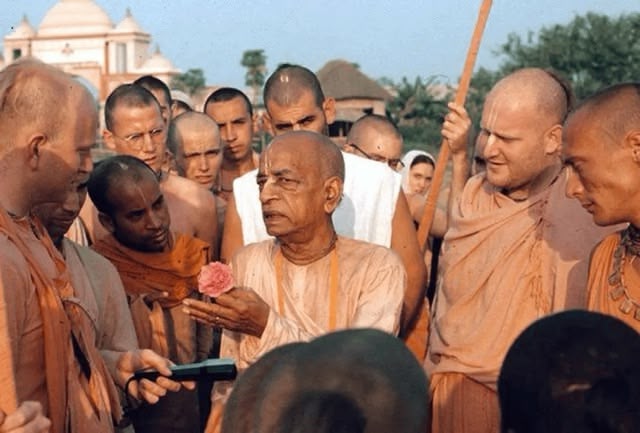
"My books will remain and teach people for thousands of years."
During the twelve years spent in the West, Srila Prabhupada turned ISKCON into a worldwide organization uniting thousands of members and comprising more than 108 temples, farming communities, schools, educational institutions, boarding schools, and other institutions.
However, Srila Prabhupada's most valuable legacy is undoubtedly his books – translations of Vedic scriptures – Bhagavad-Gita, Srimad Bhagavatam, and Chaitanya Charitamrita – from Sanskrit with extensive commentaries by the translator.
Journey to the West
After meeting his spiritual master, Srila Prabhupada dedicated his life to fulfilling his Master's order – to give Krishna consciousness to the Western world which was losing spiritual values. To fully dedicate himself to this mission, Srila Prabhupada accepted sannyasa – became a renunciant monk – in 1959.
He began translating Vedic scriptures into English, publishing and distributing newspapers and magazines carrying the spiritual message. In 1965, at the age of 65, with a few rupees in his pocket and several volumes of books translated from Sanskrit to English, he arrived in New York with a single desire: to fulfill his Master's order and give spiritual mercy to the people of the West.
ISKCON's Mission
On July 13, 1966, Srila Prabhupada registered ISKCON – the International Society for Krishna Consciousness, becoming the founder-acharya of this spiritual organization. The organization he created has changed and continues to change the lives of many people. Upon founding this Society, Srila Prabhupada outlined its mission:
- 1 To systematically propagate spiritual knowledge to society at large and to educate all people in the techniques of spiritual life in order to check the imbalance of values in life and to achieve real unity and peace in the world.
- 2 To propagate a consciousness of Krishna, as it is revealed in the Bhagavad-gita and the Srimad-Bhagavatam.
- 3 To bring the members of the Society together with each other and nearer to Krishna, the prime entity, thus developing the idea within the members, and humanity at large, that each soul is part and parcel of the quality of Godhead (Krishna).
- 4 To teach and encourage the sankirtana movement, congregational chanting of the holy name of God, as revealed in the teachings of Lord Sri Caitanya Mahaprabhu.
- 5 To erect for the members and for society at large a holy place of transcendental pastimes dedicated to the personality of Krishna.
- 6 To bring the members closer together for the purpose of teaching a simpler, more natural way of life.
- 7 With a view towards achieving the aforementioned purposes, to publish and distribute periodicals, magazines, books and other writings.
ISKCON Governance and Centers
Having founded ISKCON, Srila Prabhupada cared for it like his own child. He established the Governing Body Commission (GBC) for ISKCON, consisting of his closest disciples who became ISKCON's zonal acharyas. Since Srila Prabhupada left his body in 1977, the continuity of ISKCON's activities has been taken care of by the GBC Council, which meets at least once a year in Mayapur.
Activity Planning
The ISKCON GBC Council, meeting annually, discusses and plans ISKCON's activities, and then communicates and implements them in the regions where spiritual centers or temples are located. Each temple and its community is led by a president. GBC members regularly visit the society's temples and centers in their supervised regions, monitoring adherence to spiritual standards and activities, and providing recommendations on various issues.
Leadership
Since the founder Srila Prabhupada left this world, ISKCON has no single leader. Srila Prabhupada left an instruction that after his departure, his closest disciples and followers who became leaders should cooperate with each other and jointly spread Krishna consciousness throughout the world. The fact that the society is constantly growing shows that this instruction of Srila Prabhupada is being fulfilled.
Mayapur World Spiritual Center
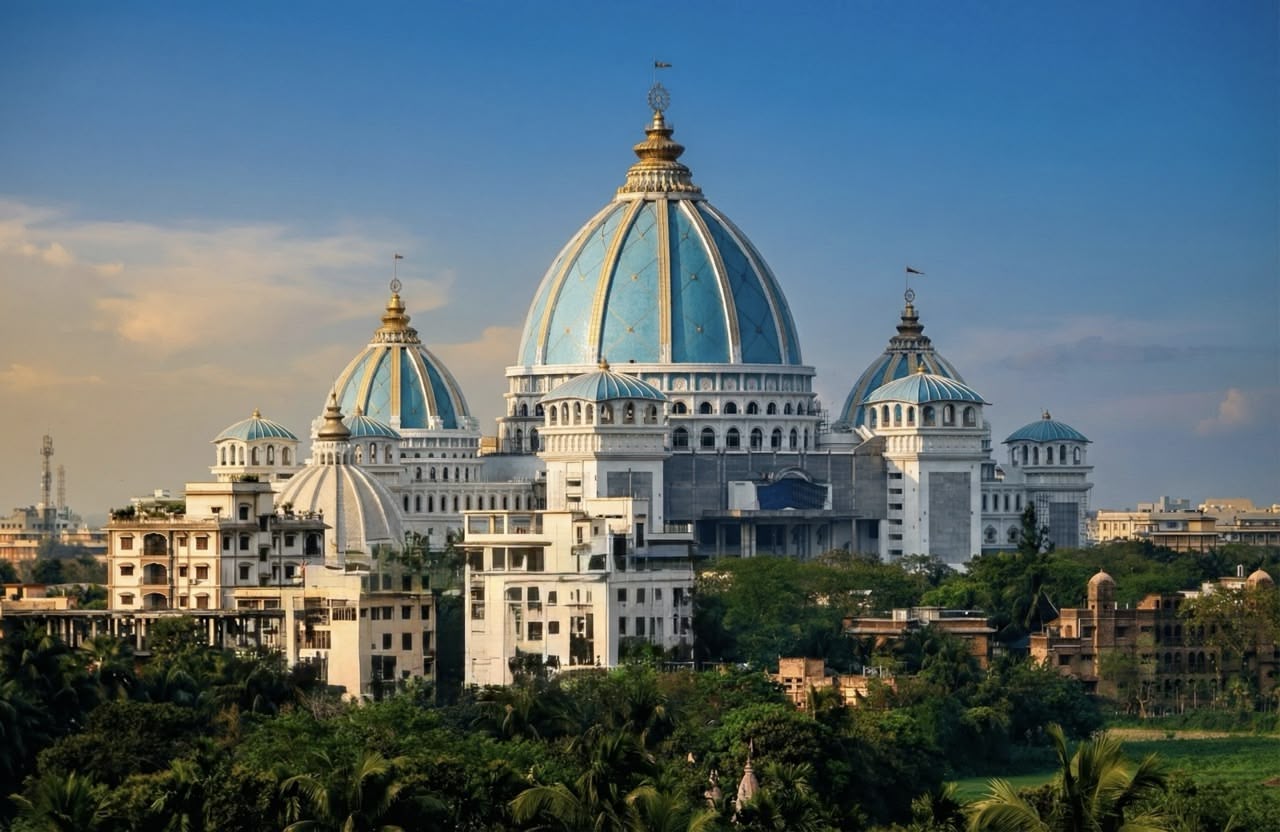
The holy city of Mayapur is famous because five hundred years ago, Lord Sri Chaitanya Mahaprabhu appeared there. Thanks to Srila Prabhupada's mercy, ISKCON established a world spiritual center in Mayapur.
Currently, the Temple of Vedic Planetarium (TOVP) is being built there.
TOVP (Temple of Vedic Planetarium)
This temple will become not only a spiritual center but also a hub of science and culture, presenting Vedic cosmology and philosophy.
Spiritual Practice
ISKCON members, following Srila Prabhupada's instructions, follow a certain religious practice: chanting the Holy Names of God and following certain regulative principles.
Harė Krišna, Harė Krišna, Krišna Krišna, Harė Harė
Harė Rama, Harė Rama, Rama Rama, Harė Harė
An adept seeking spiritual initiation – hari nama initiation – vows to chant at least 16 rounds of this mantra daily for life. (One round of the mantra consists of 108 prayer beads strung on a string, on each of which the maha-mantra is repeated).
Four Regulative Principles
Following such regulative principles may seem very strict and restrictive to many "civilized" people of today, but from the perspective of Vedic culture, these are merely minimal requirements allowing a living being to become a civilized human and distinguish themselves from the animal world based on securing four bodily instincts (eating, sleeping, mating, and defending). Everyone can easily verify that giving up harmful habits and controlling a barbaric and loose lifestyle provides more joy and satisfaction than the temporary "pleasures" provided by such a lifestyle.
Vedic Culture
In its activities, ISKCON pays great attention to the restoration and revival of spiritual Vedic culture, implementing its traditions not only in the Western world but also in modern India, which is gradually losing its deep cultural roots.
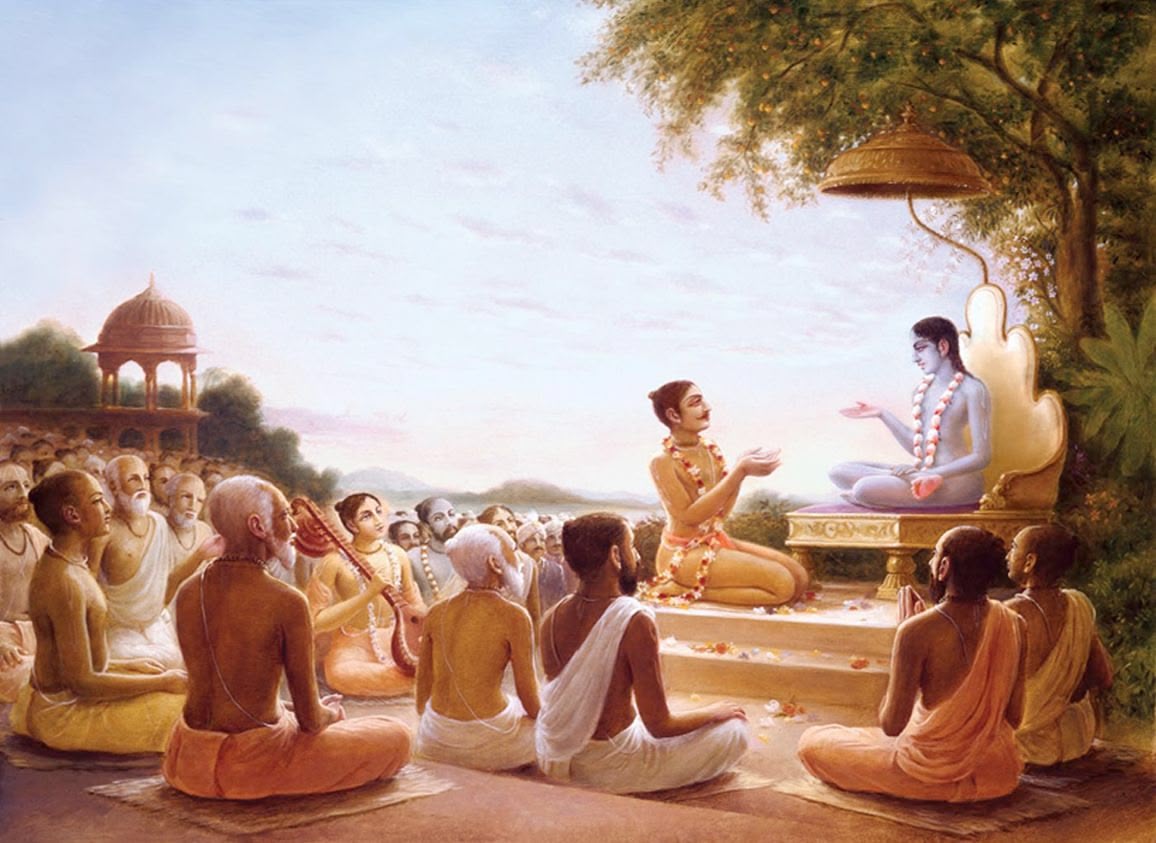
Vedic culture is a vast spiritual treasury with many rooms where everyone can find and adapt a missing and necessary value for themselves. It is like a tree with many branches, twigs, leaves, flowers, and fruits reflecting all the needs of society: spiritual, cultural, and material.
Vedic culture gives meaning to human existence and encourages striving for perfection by developing four main pillars that give meaning to existence: dharma, artha, kama, and moksha.

Dharma
Duties, religion, self, justice

Artha
Harmonious economic development

Kama
Sense gratification according to moral principles

Moksha
Self-realization, liberation
In Vedic culture, we can find a lot of other extremely valuable theoretical and practical information and instructions, essentially covering the entire space of human interests: the structure of humans and the universe, medicine, astrology, astronomy, mathematics, physics, mechanics, the art of flying and rocketry, natural sciences, chemistry, politics, sociology, warfare, logic, architecture, art, literature, poetry, psychology, ethics, aesthetics, philosophy, religion, etc. All these priceless treasures, according to the Vedas, are just many zeros gaining their value only when a one is placed in front – God. Therefore, the main goal of Vedic culture, full of immeasurable treasures, is the creation of a God-centered society. Seeing God as the axis of everything, humanity gives meaning to its talents, abilities, knowledge, and achievements.
ISKCON's Development
ISKCON, as one of the main carriers and propagators of Vedic culture in the Western world, undoubtedly has a great influence on the development, progress, morality, and formation of moral qualities of these societies.

Ethical Living
Millions of people give up meat eating and intoxicants, led by ethical and moral motives.

Spirituality
Millions of people realize that life with God is joyful and liberating.

Society
Alternative value systems based on faith, morality, and respect are being formed.
This influence is steadily strengthening as ISKCON assimilates new areas of Vedic culture. Millions of people give up meat eating, intoxicants, and many of them do so not only for health improvement but led by ethical, moral, and virtuous motives, simply realizing that it is unacceptable, barbaric, and immoral to kill one's younger brothers in order to eat them, that significantly greater satisfaction is experienced by giving up intoxicants than the joy of using them.
Millions of people realize the threat posed by gambling and loose sexual life, despite the fact that these things are advertised and imposed on us at every step. Millions of people realize that neither economic development nor sense gratification are the most important things in life that make us happy – rather the opposite.
Millions of people realize that life without God is poor and destructive, rather than joyful and liberating, as propagated by most modern "guides" and "authorities" of society, burned by lust and greed for wealth, recklessly seeking profit growth and related consumption promotion.
Millions of people increasingly realize that in order to prevent crime, stop wars, ecological catastrophes, the growing threats of radicalism and terrorist attacks, it is necessary to form other, alternative value systems in societies, based on faith, morality, virtue, honesty, respect, humility – qualities currently disappearing from public consciousness, dictionaries, and spoken language.
That the greatest scourge of humanity and societies is not economic crises and turmoil, not the imperfection of the legal base or poorly elected politicians, but the lack of qualified leaders and managers – moral, honest, capable of leading and knowing which direction to move.
That the formation of such qualities is possible only by overcoming one's own pride, arrogance, selfishness, anger, lust, and greed, developing humility and respect for other living beings, honesty, decency, the desire to create and cooperate. It is not difficult to realize that all this is possible only if we let God into our lives. In other words – if we create a God-centered society.
ISKCON is not the only one leading humanity in this direction. Many religions and spiritual movements set similar goals for themselves and, acting together, protect humanity from total destruction, self-destruction, and extinction. It is not for nothing said that as long as scriptures and at least one believer remain on earth, humanity will not perish. However, ISKCON, based on Vedic culture, its comprehensive, inexhaustible wisdom and instructions, acquires special potential to educate society leaders, personalities capable of teaching by their example and directing society in the direction of correct development.
Rapidly Developing Spiritual Movement
ISKCON is a young but rapidly developing spiritual movement. For such a movement, representing Vedic culture forming for millennia and one of the oldest known religious-philosophical doctrines on earth – sanatana dharma – eternal duty, or religion, 50 years is not a great age.
It is gratifying that ISKCON quickly noticed, identified, and took steps to change and eliminate mistakes, inappropriate behavior, and attitudes. Such an ability to self-critically analyze, notice and admit one's mistakes and select the steps needed to eliminate them testifies to the maturity of the movement achieved in a relatively short period of time.
Food Relief
From the very beginning of its activities, ISKCON has paid great attention to feeding the hungry with prasadam (mercy) – food offered to God. According to Vedic culture, there should be no starving people within a radius of several miles around temples. Today, ISKCON devotees all over the world distribute over a million portions of prasadam daily, thus supporting hungry people.
Srila Prabhupada's Books
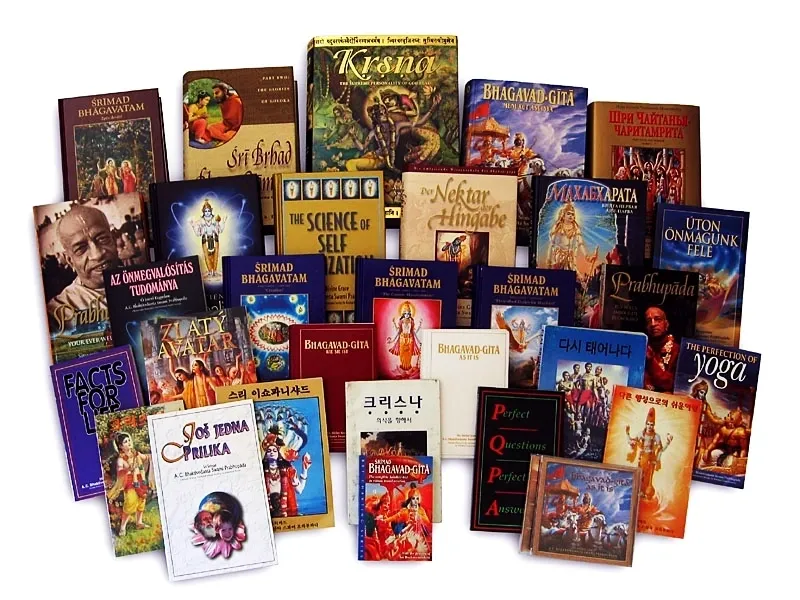
Following the instructions of Srila Prabhupada and the spiritual masters of the Brahma-Madhva-Gaudiya-Vaishnava succession – parampara, ISKCON pays very great attention to spreading Krishna consciousness in the world. For this purpose, in 1972, ISKCON's publishing unit – BBT (Bhaktivedanta Book Trust) was founded, which tirelessly publishes Srila Prabhupada's books in various languages of the world.
Books translated by Srila Prabhupada with extensive commentaries are recognized all over the world. Most famous universities, libraries, and scientific research institutes have acquired sets of these books, recognizing the authenticity of Srila Prabhupada's translations and written commentaries and their correspondence to Vedic philosophy and culture.
December Book Marathon
Prabhupada's books are distributed in various ways, mostly through the efforts of ISKCON devotees themselves, who desire to serve the spiritual master, Srila Prabhupada, and the guru parampara and provide spiritual knowledge to humanity. Every year in December, the Prabhupada Book Marathon takes place, during which devotees, seized by healthy sporting excitement, race against each other, distributing Srila Prabhupada's books without stopping and almost without rest.
Krishna Conscious Activities
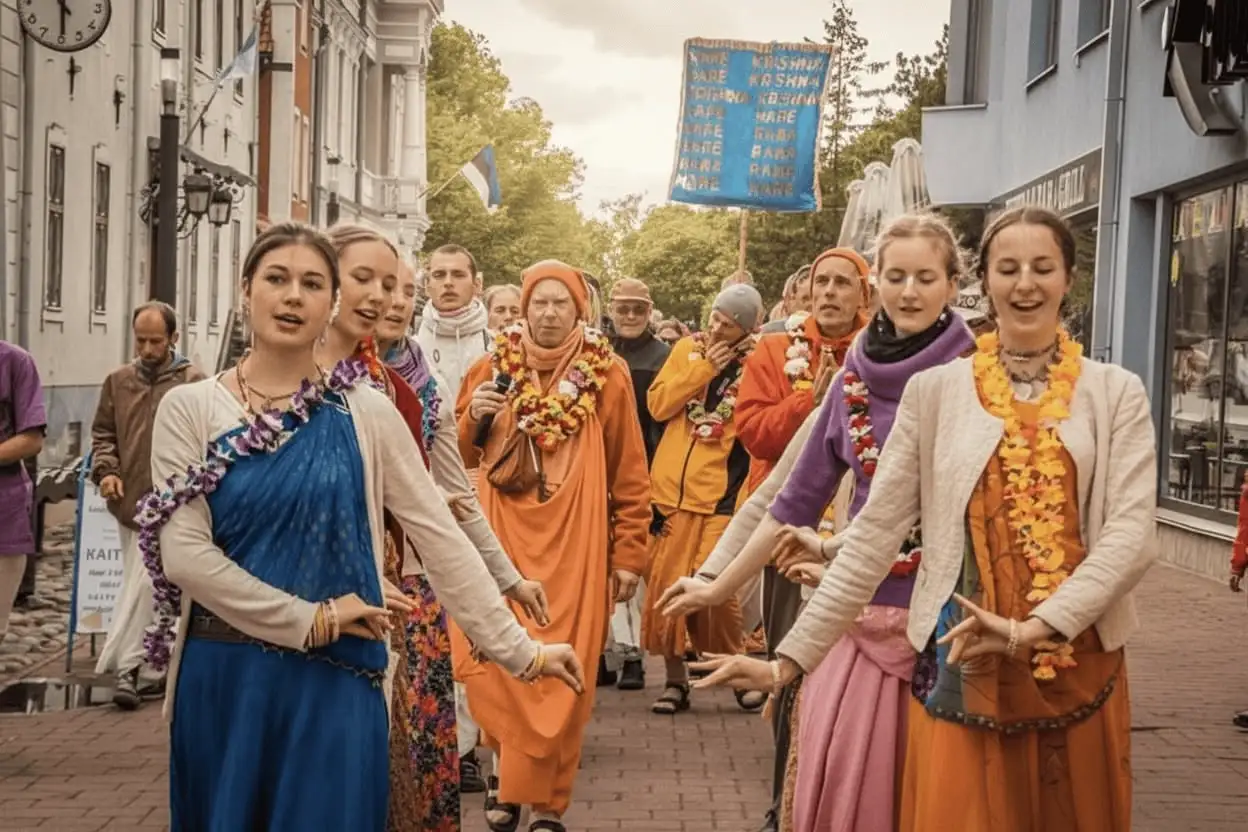
ISKCON devotees spread the ideas of the Krishna consciousness movement not only by distributing books.

Festivals and Processions
Chanting of the Holy Name. Harinamas – religious processions during which the holy names of God are glorified, giving the general public an opportunity to hear them, spiritual holidays and festivals organized by ISKCON devotees all over the world, retreats – specific retreats designed to present Vedic culture and develop Krishna consciousness, alternative organization of celebrations, cultivating the understanding that one can celebrate and have fun soberly, without intoxication, without using drugs and without debauchery,

Education and Community
Regularly held lectures and thematic seminars taking place in temples, ISKCON centers and public places, great attention paid to families and preserving their stability, establishment of monasteries – centers of spiritual enlightenment of society, establishment of rural communities, charity-support foundations, kindergartens-schools of moral education, schools of spiritual education, higher education institutions,

Social Welfare
Feeding the hungry, establishing a network of vegetarian snack bars and restaurants, organizing vegetarian cooking courses, cooking and distributing prasadam, production and distribution of organic food and cosmetic products, yoga and wellness schools and centers, care and nursing homes for the elderly, Ayurvedic beauty and massage salons,

Culture and Art
Creation and support of dance art schools or theater troupes and collectives presenting Vedic culture,

Healthy Lifestyle
The aspiration to develop the morality and ethics of ISKCON members and the entire society, as well as the ability to teach and preach by one's personal example.

Recognition
All over the world, ISKCON devotees are respected for their help in fighting the scourge of humanity, drug addiction, the ability to cure even hardened drug addicts, and ensure their socialization.
Social Experiments
Some ISKCON communities, such as Radhanatha Swami's community in Juhu (Mumbai, India), or Sivarama Swami's rural community in Hungary, have gained state recognition and state support as extremely interesting and valuable social experiments.
Temple Schedule
Every early morning, at 4:30, in hundreds of ISKCON temples, mangala arati begins, morning prayers taking place simultaneously in more than a thousand centers and thousands of devotees' homes, worshipping Deities according to the established order. After that, mantra meditation takes place, later – greeting of Deities, guru puja – ceremony of honoring the spiritual master, morning Srimad-Bhagavatam lecture and breakfast, after which devotees engage in daily work. In the evenings, a Bhagavad-Gita lecture and gaura-arati – evening prayers take place, after which hot milk is offered and drunk and everyone goes to rest.
ISKCON Worldwide
Today's ISKCON unites more than six hundred temples, rural communities, schools, and boarding schools, more than one thousand three hundred centers. The movement unites from one million to several million people who consider themselves members, friends, or sympathizers of the movement.
The movement is rapidly developing and expanding, especially in India, Africa, Russia, Ukraine, and Asian countries, as well as post-Soviet countries. This growth outweighs the little-expanding or somewhat diminished development in Western countries and the USA, characterized by very high economic development and the consequent reckless sense gratification.
Of the Baltic states, ISKCON is developing most rapidly in Lithuania, sometimes also called the "vanguard" of ISKCON.
In the territory of the former USSR, the Krishna consciousness movement was born in the heart of this empire – Moscow, which Srila Prabhupada visited in 1971, breaking through the Iron Curtain. Despite the fact that during Prabhupada's visit the KGB controlled every step, he managed to communicate with one young man who spoke to his secretary on the street, asking to sell jeans. He replied that he did not have jeans for sale, but could organize a meeting with a spiritual master – Swami. This young man, Anatoly Pinyayev, became the first initiated disciple of Prabhupada in the USSR, receiving the spiritual name – Ananta Shanti das. Through his efforts and Srila Prabhupada's mercy, Krishna consciousness spread throughout the republics of the Soviet Union.

ISKCON in Lithuania
Beginning of the Movement
The Krishna consciousness movement arrived in Lithuania in the autumn of 1979, when ISKCON devotees from Riga presented the message of Krishna consciousness to the first young people interested in Bhakti yoga at the Šiauliai Pedagogical Institute, as well as in Kaunas, at the then S. Žukas School of Applied Arts, and a little later - in Vilnius.
Community Growth
In subsequent years, the number of interested and practicing people grew steadily, especially in the period of 1980-1981, when a large group of people joined, changing their lives thanks to Krishna consciousness. Devotees began to associate with each other, gather together to glorify the names of God, honor prasadam, listen to recordings, or share spiritual knowledge, which was then difficult to access due to the lack of printed literature sources and the absence of electronic space.
In the 1980s, the first disciples appeared in Lithuania who received spiritual initiations.
Soviet Repression
In the autumn of 1981, the first clash with repressive structures took place when KGB employees, assisted by the militia, raided a program organized by devotees in an apartment in a multi-story building in Kaunas. After that, the persecution of devotees began: summons to the KGB, moral and psychological pressure, attempts to recruit as KGB informants, public hearings, expulsions from higher education institutions, dismissals from workplaces carried out with the knowledge and instruction of the KGB, reprisals against devotees by locking them up in mental hospitals or even venereal disease hospitals. Total surveillance of devotees began, listening to telephone conversations, collecting information about their friends, like-minded people, social circle, harming not only them but also their relatives, family members, and friends.

"Salted Bread" - a book about repression
Underground Press
Seeking to share spiritual knowledge and joy with other living beings, devotees began to publish the first printed publications: the magazine "Tree of Desires", the first booklets published in Russian and Lithuanian: "Chant and Be Happy", "Easy Journey to Other Planets" (in Russian), "Sri Isopanisad", "Booklet of Indian Thought" (in Russian), "Search for Liberation", "Hare Krishna - A Higher Taste". A little later, books began to be printed in a printing house, first of all - "Bhagavad-Gita As It Is", supplying them to other republics of the Soviet Union. Undoubtedly, such activity was underground and very dangerous. Devotees organized not only the printing of books but also the folding of printed sheets, cutting, binding of books, and transportation not only within Lithuania but also in the territory of the former USSR. Criminal liability threatened for each episode of such activity.
Making Prayer Beads
Through the efforts of Krishna devotees, the production of wooden prayer beads was also organized in Lithuania, distributing these beads through Moscow to devotees throughout the Soviet Union.
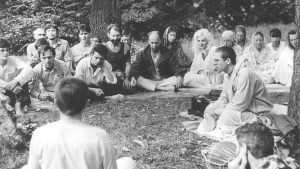
Secret programs in the forest
KGB Propaganda
Over time, KGB pressure grew and intensified, commissioned articles poured into periodical literature and the press, forming an extremely negative public attitude towards Krishna consciousness devotees, labeling them as "CIA agents", "religious fanatics", "sectarians", "mentally ill", "perverts and debauchees", "people cripplers", etc., thus morally preparing society for the complete destruction of Krishna consciousness. Lithuanian KGB employees followed instructions from the leadership in Moscow and the experience of their colleagues in Russia, Ukraine, Armenia, Georgia (especially Abkhazia) and other Soviet republics, where devotees were massively imprisoned, placed in special purpose psychiatric hospitals where they were humiliated, tortured, or even killed.
Read more about the KGB plan...
Despite the fact that the Lithuanian KGB, perhaps due to the slower and gentler nature of Lithuanians, did not equal colleagues from other Soviet Russian, Ukrainian, or southern republics in the scale of persecution and the effectiveness of reprisals, it was also intended to completely destroy Krishna consciousness in Lithuania. As archival material that became available during independence revealed, the KGB had prepared a plan providing for specific measures of influence on individual persons - starting with individual measures of influence - conversations, pressure, expulsion from higher education or workplace, and ending with elimination from society, compromising, and reprisal. In 1986, after a series of searches in devotees' apartments and houses, criminal cases began to be fabricated based on the notorious article of the Criminal Code of the Soviet Union, providing for criminal liability for "harming health under the guise of religious practice or activity". Another article of the criminal code, also used at that time to persecute Krishna devotees, was "vagrancy", which was applied when expelling them from educational institutions and giving instructions to institutions and organizations not to employ such persons.
First Festival and Breakthrough
In the autumn of 1986, Lithuanian Krishna consciousness devotees gathered together for the first time to celebrate Janmashtami - the appearance day of Lord Krishna. The celebration was planned in the premises of the B. Sruoga Museum in Biržai, where one of the devotees worked as a watchman. The KGB, having learned in advance about this gathering prepared by the devotees, organized a republican operation, during which almost all Lithuanian security forces were thrown in to detain and catch the "sectarians".
Western society strongly criticized such persecution of believers in the Soviet Union. Society and human rights organizations were immediately informed about all criminal cases, detentions, searches, dismissals, forced "treatments", beatings, and murders. In the Soviet Union and Lithuania, such information could be heard through "Voice of America", "Radio Free Europe" - information mouthpieces of the free Western society intended for Soviet countries. Throughout the entire existence of the Soviet Union, despite constant interference, attempts to block radio communication, anger, and malice poured on these radio stations in the Soviet mass media, the KGB failed to stop and stifle this flow of free information reaching the enslaved part of humanity.
End of Oppression
All this KGB madness and bacchanalia, aiming to completely destroy Krishna consciousness by chasing, persecuting, and even physically destroying its followers, was stopped in 1986 by the "perestroika" started by Mikhail Gorbachev, the then President of the Soviet Union, which eventually led the Soviet Union to collapse and ruin. The KGB received instructions to curb their "zeal" in persecuting devotees. At the same time, pressure on other religious denominations also decreased. In 1986, the process of releasing devotees from prisons and special purpose psychiatric hospitals began, and they stopped being expelled from workplaces and educational institutions. Six months later, criminal cases against Lithuanian Krishna consciousness devotees were terminated.
Information about the persecutions was broadcast via "Voice of America" and "Radio Free Europe". This helped stop the KGB's arbitrariness.
Fight for Freedom
Sensing new winds, believers immediately began the fight for their freedom of conscience and rights. The first victory achieved was the return of personal items, recordings, and religious paraphernalia confiscated and seized during searches. This was only possible after two years of pressure and consistent correspondence with the militia, the prosecutor's office, city committees, the Council of Ministers of the Lithuanian SSR, and the Supreme Soviet of the USSR. It was especially difficult to recover some items "privatized" by the KGB for personal needs: Western sound recording and reproduction equipment, original Western editions of books, magazines, or records. Some items remained unreturned. Also, confiscated circulations of printed books were not returned.
Legalization and first procession...
At the same time, concern was raised about the legalization and registration of Krishna consciousness in Lithuania. For this purpose, communication and correspondence took place with city committees, the Supreme Soviet of the Lithuanian SSR, the Council for Religious Affairs under the Council of Ministers of the Lithuanian SSR, the Supreme Soviet of the USSR, and the Council for Religious Affairs under the Council of Ministers of the USSR. In 1987, Vaishnavas devoted to Krishna organized the first street procession, which the KGB and militia employees, who watched and followed it vigilantly, did not dare to take repressive measures against and did not stop. This happened a week earlier than the Lithuanian Freedom League organized its first procession. Devotees began an open fight for freedom of conscience. Nevertheless, the KGB soon came to their senses and, acting together with the militia, stopped the Krishna consciousness devotees' procession held a little later that same year in Kaunas, detaining its participants.
First Ratha Yatra
In 1989, through the efforts of ISKCON devotees, the first Ratha Yatra - chariot festival-procession - was held in Kaunas, when Deities, following the tradition established in the Indian city of Jagannatha Puri and famous all over the world, are placed in a chariot(s) and, pulling it (them) with ropes, are driven through the city streets, singing and glorifying the names of God. This was the first Ratha Yatra in the entire Soviet Union, starting a new tradition in many cities.
Constant pressure, attacking with letters, demands, and reminders, finally bore fruit: After the decision adopted by the Council for Religious Affairs under the Council of Ministers of the USSR in 1988 to allow the legalization of the Krishna consciousness movement in Russia (ISKCON became the first "new" religious denomination registered in the USSR since the revolution), similar decisions were also adopted in Lithuania, registering the Vilnius and Kaunas KC religious communities (in 1988 and 1989 respectively). Thus, the Krishna consciousness movement was legalized in Lithuania.
Despite the fresh wind of perestroika, the KGB did its job. Devotees were still followed, attempts were made to interfere in their lives, to compromise them in the eyes of society. Unable to withstand constant persecution and difficulties, quite a few devotees emigrated to the Western world, where they were recognized as political refugees who suffered in the fight for freedom of conscience.
First Temple
In 1988, devotees of the Krishna consciousness movement purchased a residential building at Raudonosios Armijos (now Savanorių pr.) 37, Kaunas. By fate, this building became the first temple of the Krishna consciousness movement in the entire former USSR.
In 1993, Deities were officially installed in this temple, and it was named the Kaunas Sri Sri Nitai Gaura-chandra Temple.
In Vilnius, a temple was established in the building marked number 23 on Raugyklos Street, naming it (according to the names of the Deities worshipped) - Vilnius Sri Sri Nitai Gaurasundara Temple.
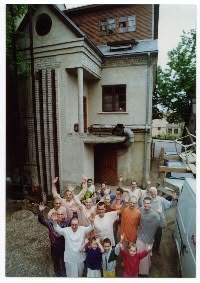
First Temple in Kaunas
Regular services are held in the temples, following the procedure approved and valid for all ISKCON temples. Shortly after the restoration of Lithuania's independence, the religious communities of Krishna consciousness in Šiauliai, Klaipėda, and Visaginas were registered. However, after the ISKCON GBC adopted a resolution to limit itself to two temples in Lithuania at that time - Vilnius and Kaunas, the registration of the latter communities was not renewed.
Communities in Lithuania
In recent years, with the increase of Krishna consciousness devotees and the expansion of the movement, the GBC policy has changed, therefore the following were registered:
Community "Bhaktivedanta"
Kaunas
Pajieslys Community
Kėdainiai dist.
Public Institution "Dvaraka – Capital of Krishna"
Kaunas
Community "New Gokula"
Kelmė
Vaishnava Monastery
Pajieslys
"Nomen sancty monastery" (Holy Name Monastery)
Paltininkai village, Kaišiadorys dist.
Klaipėda Community
Klaipėda
Other Activities and Projects
Krishna consciousness support-charity foundations and a public institution engaged in organizing national Vaishnava festivals have been established in various cities:
Summer and Winter Festivals
festivals.lt
Padayatra (pilgrimage journey)
Annual Ratha-yatra Festival
Republican Janmashtami Celebration
A whole series of Vedic culture and Vaishnava centers have also been registered in various Lithuanian cities and towns.
Community Contacts: Contacts
Lithuanian Society for Krishna Consciousness
With the increase of Krishna consciousness religious communities, Vedic culture and Vaishnava centers in Lithuania, there is a need to coordinate the movement's activities not only in separate cities but also throughout the Republic.
Therefore, it is planned to establish the Lithuanian Society for Krishna Consciousness, uniting all Krishna consciousness movement communities and organizations in Lithuania.
For this purpose, even before officially registering such a society, National Assemblies of the Krishna consciousness movement in Lithuania have been regularly held for the past few years, in which leaders or representatives of communities and centers participate.
Such meetings take place four times a year. The resolutions of the meeting are coordinated with the ISKCON GBC and, upon receiving approval or confirmation, become mandatory for all units of the Krishna consciousness movement in Lithuania.
National Assemblies of the Krishna consciousness movement lay the foundations for the formation of the National Council – the future governing institution of the Lithuanian Society for Krishna Consciousness.
Social Role and Values
The Lithuanian Krishna consciousness movement, like other ISKCON organizations all over the world, focusing great attention on the education of its members, the formation of their moral-ethical qualities, the creation of strong, stable families, the socialization of movement members, the education and upbringing of its members and the entire society, the upbringing of children, social welfare, the spread of priceless Vedic culture, undoubtedly plays a large and steadily growing role in forming a healthy society, strengthening its morality and ethics, educating honest, dutiful citizens of the state who do not shirk responsibility.
Dhruvananda das
Author of the article