Harmonium
Melodic instrument for kirtan - Narada Muni scale
Harmonium
The harmonium is made of wood, metal, brass, and cloth. It is a portable wooden box that originated in West Bengal. Thus, the harmonium has become an integral part of Indian music.
Keys are played and bellows are compressed simultaneously. When the bellows are compressed, air passes through a reed, causing it to vibrate and produce sound. Reeds regulate the tone/pitch, while the bellows produce and control the air and volume.
Harmonium in the West
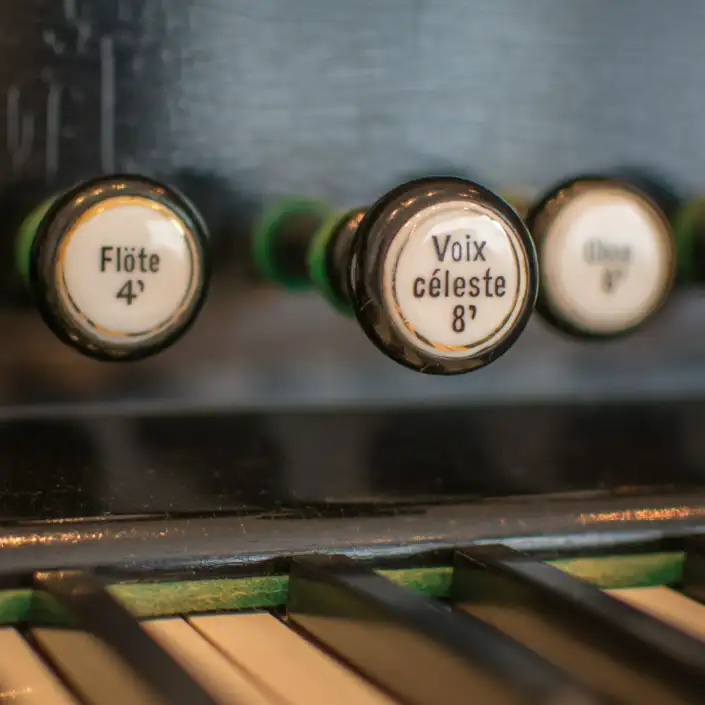
The harmonium was created in the 1700s by Christian Gottlieb Kratzenstein, a professor of physiology at the University of Copenhagen. His harmonium design was similar to a small-sized organ. It produced sound using foot-operated bellows that allowed wind to pass through a pressure-equalizing air reservoir, causing metal reeds to vibrate.
The volume of the instrument was controlled by knee-operated valves, knobs placed above the keyboard allowing wind supply to bypass the reservoir, and the force used to pump the bellows.
When Europeans emigrated to the USA, they introduced the harmonium to Americans. Eventually, the instrument found its way to colonies in Asia, Africa, and the Caribbean.
In the early 20th century, the use of the harmonium declined in the Western world due to changing musical tastes. Thus, the European harmonium lost demand and began to be found only in museums.
Harmonium in India
This dying instrument got a second life in India. In 1875 in Calcutta, Dwarkanath Ghose created his Indian version of the harmonium, which is hand-pumped. Traditionally, it was used by Indian classical musicians who sat on the floor during performances.
The foot-operated bellows located under the keyboard in the European harmonium were replaced by hand-operated bellows at the back in the Indian version. The new incarnation of the harmonium was more durable, cheaper, and easier to maintain and repair. Ghose simplified the internal mechanism of the instrument. To adapt the harmonium to Indian classical music, drone knobs were added to the instrument, as well as a scale-changing mechanism. Since 1915, India has become the main producer of harmoniums.
In this way, the harmonium became an integral part of Indian music. It is widely used in temples during kirtans.
Quotes
"Vishnujana happily undertook to teach how to play the harmonium and brings Ravindra to the bus, whom he quickly taught to play the harmonium, as Prabhupada originally taught.
Ravindra Svarupa: He gave me a five-minute lesson. I thought it was the most incredible five-minute music lesson. In my youth, I played the violin, even played the sousaphone, so I knew something about music. He gave me a condensed version so that if I continued, I would become proficient. He showed me what he called the spiritual scale. Srimad-Bhagavatam mentioned that this is the scale sung by Narada Muni. He said: "Play in this scale when you play the harmonium and play mostly on the black keys. Then he showed me how he played Gopinatha, and that was it. He was a very good teacher."
— Radha Damodara Vilasa
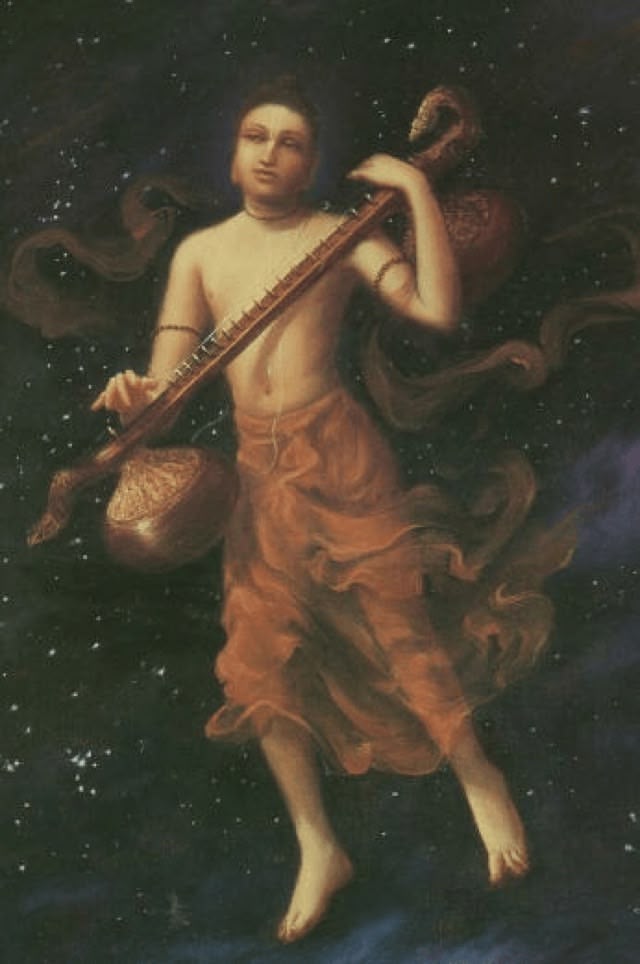
The seven musical notes, namely ṣa (ṣaḍja), ṛ (ṛṣabha), gā (gāndhāra), ma (madhyama), pa (pañcama), dha (dhaivata), and ni (niṣāda), are also transcendental and meant for transcendental songs. Being a pure devotee of the Lord, Śrī Nāradadeva is always engaged in his duty to the Lord; having received the instrument as a gift, he always sings His transcendental glories and is therefore infallible in his exalted position.
Following in the footsteps of Śrīla Nārada Muni, a self-realized soul in the material world also properly uses the musical scales, namely ṣa, ṛ, gā, mā, etc., in the service of the Lord, constantly singing His glories. As confirmed in the Bhagavad-gītā (9.14), the mahātmās, or great souls, have no business in life other than chanting the transcendental glories of the Lord.
— Srimad Bhagavatam 1.6.32Music and dancing used for sense gratification should be accepted as demoniac, but the same music and dancing, when used to glorify the Supreme Lord with kīrtana, is transcendental and makes life completely fit for spiritual enjoyment.
— Srimad Bhagavatam 3.20.38