Karatals
The divine rhythm instrument for kirtan
Karatals
We live in a space filled with different sounds. Neighbors' noise, hissing cars, endless mobile phone ringing, various noises – all this invades our lives every second. We communicate through sound, through which we express feelings, influence, bless or anger. Some sounds fascinate us, while others cause shivers. However, there are sounds that can purify thoughts. This includes, for example, the sound emitted by a bell. The vibrations emanating from the bell not only bring clarity and joy to the mind, but also have the ability to heal diseases. It has been experimentally proven that flu and yellow fever viruses die, unable to withstand bell "therapy".
There is an instrument in the world called karatalas. Translated from Sanskrit, "kara" means hand, and "tala" means rhythmic structure. However, karatalas are not just a hand rhythm instrument. This is a divine instrument, and in ancient Vedic texts its greatness is described as follows:
mrityu jaeya samana jayyam
tat kikaras kapi sukha jayyam
srutveti durat karatala shabdat
sakirtaka te khalu yopayanti
"I will conquer Death, I will conquer Yamaraja and happily conquer all his servants (Yamadutas). Hearing the sound of karatalas from afar, neither Death, nor Yamaraja, nor his servants will certainly be able to approach the one who performs this kirtan."
To learn, ask for blessings
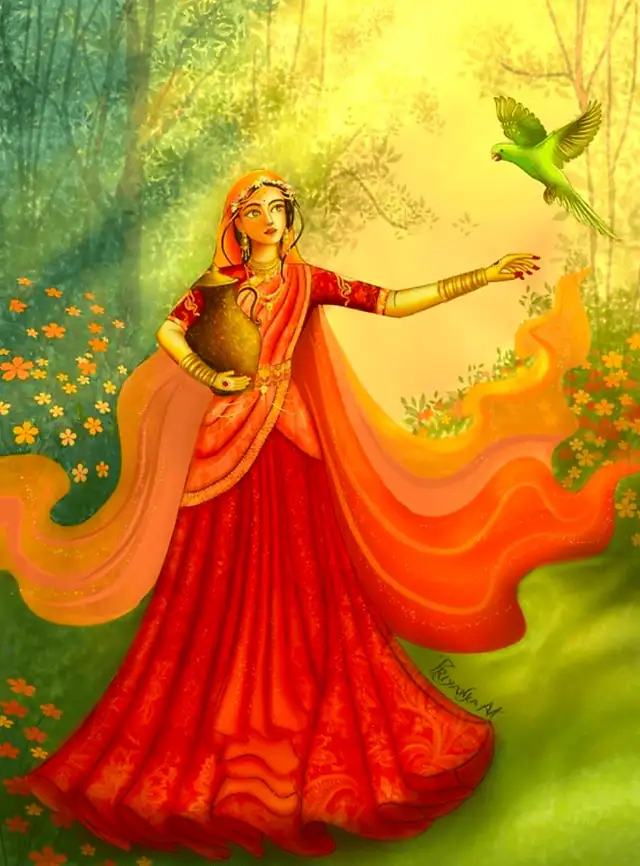
Thus, karatalas are not just an instrument, they are literally a weapon that protects on the subtle plane, destroying with their vibration the background unfavorable to consciousness. Karatalas are so wonderful that when they are played, one of the divine energies is awakened, which is called mohini shakti – the energy of miracle. To learn to play karatalas correctly, it is necessary to receive the blessing of their guardian. The Vedas say that such a guardian is Sudevi, a young girl with golden skin, wearing clothes that resemble the color of coral. Until we have a connection or understanding of who Sudevi is, we should ask for the blessings of the spiritual teacher.
Functionally, karatalas create a rich rhythm pattern, but this is not the main thing. The essence of Sudevi's skills is that she plays to serve Sri Krishna and Sri Radha (the divine couple), and karatalas will be able to fully manifest only if we can adopt this mood.
To learn to play karatalas, a person who knows how to play karatalas well is very important. Bhakti practice involves chanting the names of God together with musical instruments. This is called kirtan. A good karatala player is not only a musician who can skillfully move from one tala (rhythm) to another tala. First of all, this is a person inspired to be part of the entire kirtan group, not a lonely soloist. And if such a person appears, then miraculously the karatalas in his hands can sound like a solemn gong, a gentle bell, or even like a bird's song... Karatalas mystically acquire the ability to convey emotions. When kirtan participants equally desire to help each other during spiritual practice, the Lord Himself gives them everything they need so that the offering to Him is complete.
How to choose karatalas?
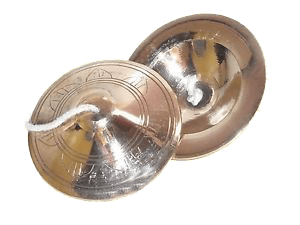
It should be noted that high-quality karatalas are made of white brass, both plates are tuned to the same tone. If they differ in tuning and tone, an unpleasant sound will appear. Therefore, it is necessary to select karatalas very carefully. When choosing an instrument, it should be remembered that "heavy" karatalas have a low sound, and "light" ones have a high sound:
- it is not recommended to buy thick karatalas, i.e. with large plate walls. The outer edges of the discs should not be damaged;
- make sure that when struck, good karatalas emit a long sound: the longer the sound, the louder the instrument;
- each cymbal must emit a sound identical to its pair.
How to produce sounds?
How to do it correctly – hitting the edges of the plates or their middle? The sound vibration must be chosen depending on the type of kirtan you will sing and play. Medium-sized karatalas are suitable for almost any type of kirtan. Large karatalas, used together with singing, often at the end of kirtan, to glorify Lord Krishna. These karatalas are most often used outside the temple, under the open sky.
Children are not recommended to play large karatalas, as they need a good ear for music to produce pleasant sounds. Incorrect playing can spoil the melody. If large karatalas produce a large and loud sound, then small ones are more pleasant and softer. The sound of both should not be mixed, as together they are not harmonized.
Try to produce a good sound, the performer's ears will appreciate it. Others will also enjoy listening to a beautiful melody. Rough sounds should be avoided.
If you hit the karatala in the center, a very sharp sound will be heard. If you hit the edge, it will be a gentle sound. If you hit the corner of the karatala, then it will be clear. Thus, by hitting different parts of the karatalas, they produce different sounds.
Video lessons
First lesson: where to start
How to hold them and the simplest rhythm.
Second lesson: steady rhythm
How to learn to maintain a steady and correct rhythm.
Third lesson: fast rhythm
How to learn to play a fast rhythm.
Fourth lesson: tehai, transition
At the end of a mantra or verse, a special embellishment is usually played with karatalas, which is called Tehai. This is a special transition that can be of various lengths. In this lesson I will show the shortest and simplest transition. Simple transitions consist of a mantra that is played 3 times. This lesson's mantra: ti ni ti ni ta / ti ni ti ni ta / ti ni ti ni ta