Krishna Consciousness at Home
A practical guide on how to practice devotional service in your home
Introduction
In the book "Search for Enlightenment", Śrīla Prabhupāda clearly shows how important it is for everyone to practice Krishna consciousness, devotional service to Lord Kṛṣṇa. Of course, it is easier to perform devotional service while living in the association of Kṛṣṇa devotees in a temple or ashram. But if you are determined, you can follow the teachings of Kṛṣṇa consciousness at home and thus turn your home into a temple.
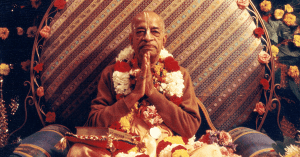
Śrīla Prabhupāda
Most Important
To accept the instructions of the scriptures and the guru.
Spiritual life, like material life, means practical activity. The difference is that we perform material activity for our own benefit or for the benefit of those we consider our own, while we perform spiritual activity for the benefit of Lord Kṛṣṇa, under the guidance of the scriptures and the spiritual master. The most important thing is to accept the instructions of the scriptures and the guru. In the Bhagavad-gītā, Kṛṣṇa states that a person cannot achieve happiness or the supreme goal of life – to return to God, to return to Lord Kṛṣṇa – if he does not follow the instructions of the scriptures.
And how to follow the rules of the scriptures in performing practical service to the Lord is explained by an authoritative spiritual master. Without following the instructions of a spiritual master who is in an authoritative disciplic succession originating from Kṛṣṇa Himself, we cannot make spiritual advancement.
The practices described here are the timeless practices of bhakti-yoga given by the foremost spiritual master and exponent of Krishna consciousness in our times, His Divine Grace A.C. Bhaktivedanta Swami Prabhupāda, Founder-Acharya of the International Society for Krishna Consciousness (ISKCON).

The Goal of Spiritual Knowledge
The goal of spiritual knowledge is to bring us closer to God, or Kṛṣṇa. Kṛṣṇa says in the Bhagavad-gītā (18.55), bhaktyā māṁ abhijānāti: "I can be known only by devotional service." Knowledge teaches us how to act properly.

Practical Application
Spiritual knowledge directs us how to satisfy Kṛṣṇa's desires by practically engaging in loving service to Him. Without practical application, theoretical knowledge is of little value.
"Spiritual knowledge is meant to guide us in all aspects of life. Therefore, we should try to organize our lives in such a way that we follow Kṛṣṇa's teachings as much as possible. We should try to do everything as well as possible. Then we will be able to rise to the transcendental platform of Krishna consciousness, even while living far from a temple."
Chanting the Hare Krishna Mantra
The first principle of devotional service is chanting the Hare Krishna mahā-mantra (mahā means "great"; mantra means "sound that liberates the mind from ignorance"):
Hare Krishna, Hare Krishna, Krishna Krishna, Hare Hare
Hare Rama, Hare Rama, Rama Rama, Hare Hare
1 When to Chant?
You can chant these holy names of the Lord anywhere and anytime, but it is best to set a specific time of day to chant regularly. Early morning is the ideal time.
2 How to Chant?
Chanting can be done in two ways: singing the mantra, called kīrtana (usually done in a group), and chanting the mantra individually, called japa (which literally means "to speak softly").
Focus and Meaning
Concentrate on the sound of the holy names. Chant clearly and pronounce the names distinctly, addressing Krishna in a prayerful mood. When your mind wanders, bring it back to the sound of the Lord's names.
The more attentively and sincerely you chant these names of God, the more spiritual progress you will make.
The Power of God's Names
Since God is all-powerful and all-merciful, He has kindly made it very easy for us to chant His names, and He has also invested all His potencies in them. Therefore, God's names and God Himself are identical.
This means that when we chant the holy names of Krishna and Rama, we are directly associating with God and are being purified. Therefore, we should always try to chant with devotion and reverence. Vedic literature states that Lord Krishna personally dances on the tongue when His holy names are chanted.
📿 Chanting on Japa Beads
When chanting alone, it is best to chant on japa beads (available at your nearest temple). This not only helps fix your attention on the holy name, but also helps you count the number of times you chant the mantra daily. Each string of japa beads contains 108 small beads and one large bead—the head bead.
Begin with the bead next to the head bead and gently roll it between the thumb and middle finger of your right hand while chanting the full Hare Krishna mantra. Then move to the next bead and repeat the process. Chant on each of the 108 beads in this way until you reach the head bead again. This completes one round of japa. Then, do not chant on the head bead, but turn the beads around and start the second round from the last bead you chanted on.
Initiated devotees vow before the spiritual master to chant at least sixteen rounds of the Hare Krishna mantra. However, if you can only chant one round a day, the principle is that it is best to commit to chanting a certain number of rounds and try to complete it every day. When you feel you can chant more, then increase the minimum number of rounds you chant daily, but do not go below that number. You can chant more than the fixed number, but you should maintain the set minimum every day.
⚠️ Important:
(Please note that the beads are sacred and should therefore never touch the ground or be kept in an unclean place. To keep the beads clean, it is best to carry them in a special bead bag, which you can also find at your nearest temple.)
Chanting the Mahamantra
In addition to chanting japa, you can also sing the Lord's holy names in kirtana. Although you can perform kirtana alone, it is usually performed with others. A melodious kirtana with family or friends is sure to inspire everyone. ISKCON devotees use traditional melodies and instruments, especially in the temple, but you can sing any melody and use any musical instruments to accompany your chanting.
As Lord Chaitanya said: "There are no hard and fast rules for chanting Hare Krishna".
However, one thing you might want to do is download some beautiful kirtans for listening.
Setting up a Home Altar
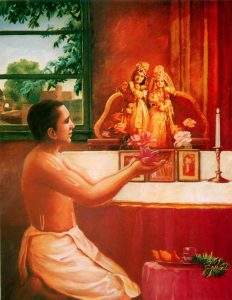
You will probably notice that your japa and kirtana are especially effective when done before an altar. Lord Krishna and His pure devotees are so kind that they allow us to worship them even through their pictures. It is something like mailing a letter: you cannot mail a letter by placing it in just any box; you must use a government-authorized mailbox. Similarly, we cannot imagine a picture of God and worship that, but we can worship an authorized picture of God, and Krishna accepts our worship through that picture.
Setting up an altar at home means receiving the Lord and His pure devotees as the most honored guests. Where should you set up the altar? Well, how would you seat a guest? An ideal place would be clean, well-lit, and free from drafts and household disturbances. Your guest, of course, would need a comfortable chair, but for a picture of Krishna's form, a wall shelf, a mantelpiece, a corner table, or the top shelf of a bookcase will do. You wouldn't seat a guest in your home and then ignore him; you would also provide a place for yourself to sit where you could comfortably enjoy his company. So don't make your altar inaccessible.
What do you need for an altar?
Here are the most important things:
- 1. A picture of Srila Prabhupada.
- 2. A picture of Lord Chaitanya and the Pancha Tattva.
- 3. A picture of Sri Sri Radha-Krishna.
In addition, you might want an altar cloth, water cups (one for each picture), candles with holders, a special plate for offering food, a small bell, incense, an incense holder, and fresh flowers, which you can offer in vases or simply place before each picture. If you are interested in more elaborate deity worship, ask any ISKCON devotee or write to your nearest Temple.
1️⃣ The First Picture
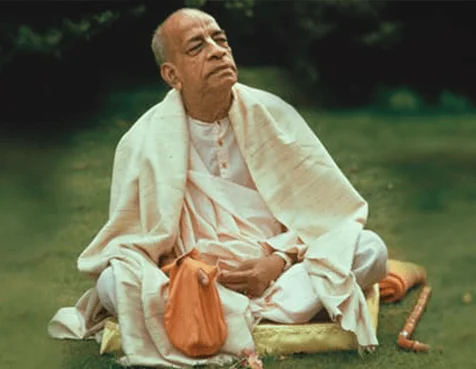
The first person we worship on the altar is the spiritual master. The spiritual master is not God. Only God is God. But because the spiritual master is His most dear servant, God has empowered him, and therefore he deserves the same respect as God. He connects the disciple with God and teaches the process of bhakti-yoga. He is God's ambassador in the material world. When the president sends an ambassador to a foreign country, the ambassador receives the same respect as the president, and the ambassador's words are as authoritative as the president's. Similarly, we should respect the spiritual master as we would God, and respect his words as we would His.
There are two main types of gurus: the instructing guru and the initiating guru. Anyone who takes up the process of bhakti-yoga through contact with ISKCON owes an immense debt of gratitude to Srila Prabhupada. Before Srila Prabhupada left India in 1965 to spread Krishna consciousness abroad, almost no one outside of India knew anything about pure devotional service to Lord Krishna. Therefore, everyone who has learned about the process through his books, "Back to Godhead" magazine, lectures, or contact with devotees, should respect Srila Prabhupada. As the founder-acharya and spiritual guide of the International Society for Krishna Consciousness, he is the instructing guru for all of us.
As you progress in bhakti-yoga, you will eventually want to accept initiation. Before leaving this world in 1977, Srila Prabhupada authorized a system by which advanced and qualified devotees would continue his mission and initiate disciples according to his instructions. Currently, there are many spiritual masters in ISKCON. To find out how you can contact them for spiritual guidance and association, ask the devotees at your nearest temple or write to one of the ISKCON centers.
2️⃣ The Second Picture
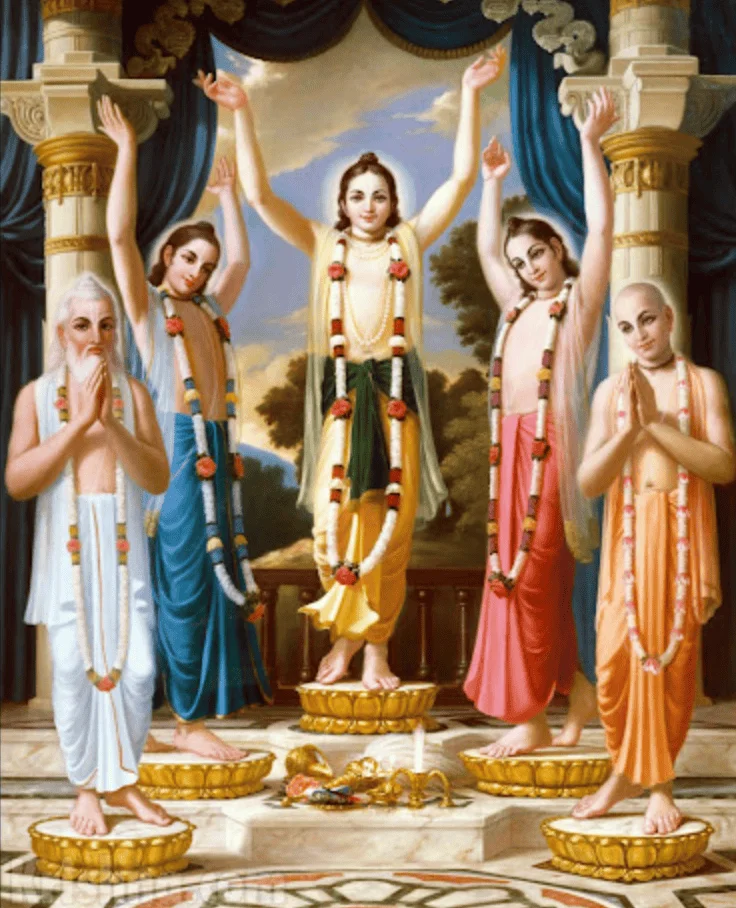
On your altar should be a picture of the Pancha-tattva, Lord Chaitanya and His four principal associates. Lord Chaitanya is the incarnation of God for this age. He is Krishna Himself, who appeared as a devotee to teach us how to surrender to Him, specifically by chanting His holy names and performing other bhakti-yoga activities. Lord Chaitanya is the most merciful incarnation because He makes it easy for anyone to attain love of God by chanting the Hare Krishna mantra.
3️⃣ The Third Picture
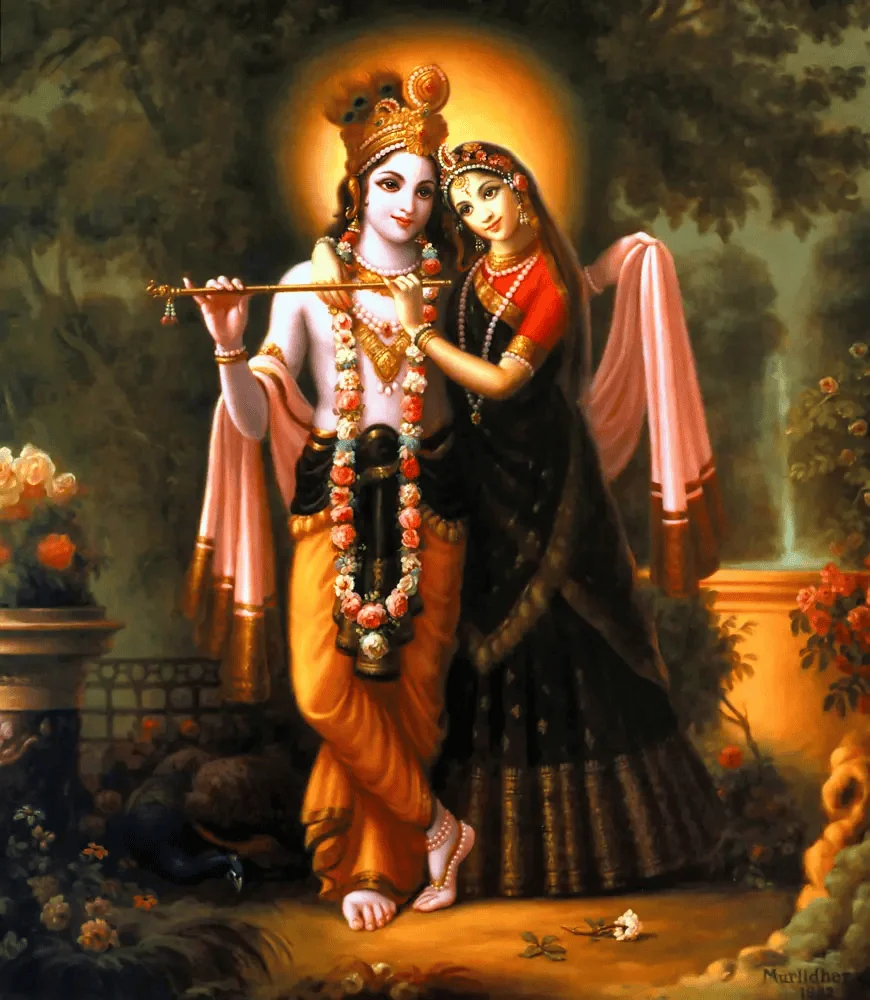
Of course, your altar should have a picture of the Supreme Personality of Godhead, Lord Sri Krishna, with His eternal consort Srimati Radharani. Srimati Radharani is Krishna's spiritual potency. She is devotional service personified, and devotees always take shelter of Her to learn how to serve Krishna.
You can arrange the pictures in a triangle. On the left – the picture of Srila Prabhupada, on the right – the picture of Lord Chaitanya and His associates, and the picture of Radha and Krishna, which, if possible, should be slightly larger than the others – on a small raised platform in the center. Or you can hang the picture of Radha and Krishna on the wall higher up.
✨ Daily Maintenance
Clean the altar carefully every morning. Cleanliness is essential in Deity worship. Remember that you wouldn't neglect to clean an important guest's room, and by establishing an altar, you are inviting Krishna and His pure devotees to live as the most important guests in your home. If you have water cups, rinse them and fill them with fresh water daily. Then place them conveniently near the pictures. You should change flowers in vases as soon as they wilt slightly, or daily if you offered them at the pictures without a vase. You should offer fresh incense at least once a day, and if possible, light candles and place them near the pictures when you chant before the altar.
Try the things we have suggested so far. It is actually very simple: if you try to love God, you will gradually realize how much He loves you. That is the essence of bhakti-yoga.
Prasadam: How to Eat Spiritually
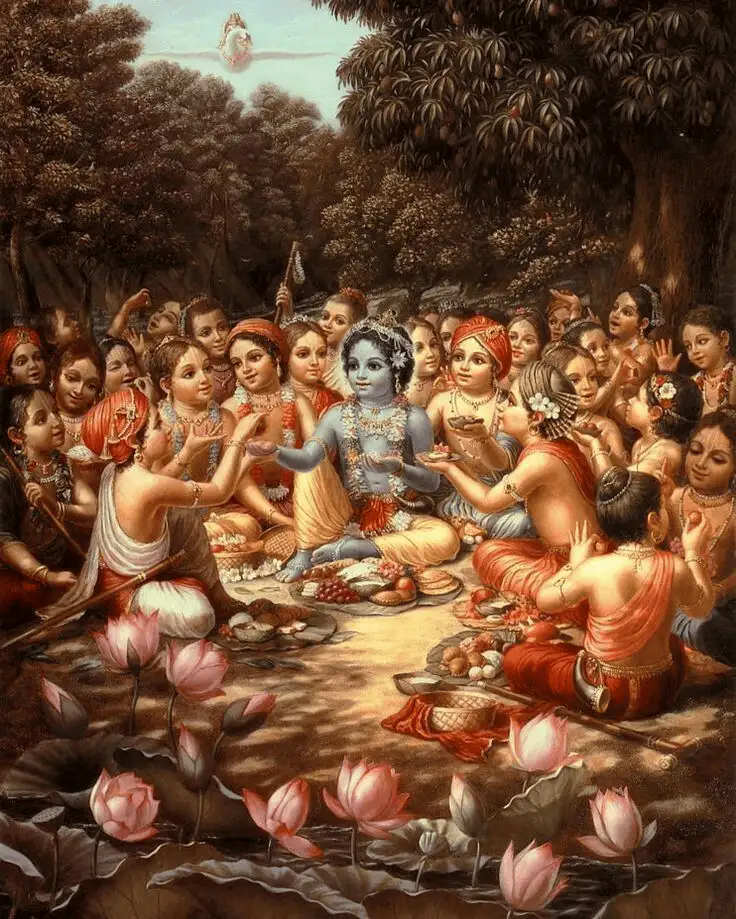
By His immense transcendental energies, Krishna can actually transform matter into spirit. If we put an iron rod into a fire, before long the rod becomes red hot and acts just like fire. Similarly, food prepared for and offered to Krishna with love and devotion becomes completely spiritualized. Such food is called Krishna prasadam, which means "the mercy of Lord Krishna".
Eating prasadam is a fundamental practice of bhakti-yoga. In other forms of yoga, one must artificially repress the senses, but a bhakti-yogi can engage his senses in a variety of pleasing spiritual activities, such as tasting delicious food offered to Lord Krishna. In this way, the senses gradually become spiritualized and bring the devotee more and more transcendental pleasure in devotional service. Such spiritual pleasure far surpasses any material experience.
Lord Chaitanya said about prasadam:
"Everyone has tasted these foods before. However, now that they have been prepared for Krishna and offered to Him with devotion, these foods have acquired extraordinary tastes and unusual fragrances. Just taste them and see the difference. Experience! Besides the taste, even the fragrance pleases the mind and makes one forget other smells. Therefore, it should be understood that the spiritual nectar of Krishna's lips must have touched these ordinary foods and given them all their transcendental qualities."
Eating only food offered to Krishna is the perfection of vegetarianism. Being a vegetarian is not enough; after all, even pigeons and monkeys are vegetarians. But when we go beyond vegetarianism to a diet of prasadam, our eating becomes helpful in achieving the goal of human life—reviving the soul's original relationship with God. In the Bhagavad-gita, Lord Krishna says that if you eat only food that has been offered to Him, you will not suffer the reactions of karma.
How to Prepare and Offer Prasadam
As you walk down the supermarket aisles selecting foods to offer to Krishna, you need to know what is offerable and what is not. In the Bhagavad-gita, Lord Krishna states: "If one offers Me with love and devotion a leaf, a flower, a fruit or water, I will accept it".
Offerable
- • Dairy products
- • Vegetables and fruits
- • Nuts and grains
- • Water
You can buy "Hare Krishna" cookbooks at the temple, and you can easily find many recipes online.
Not Offerable
- • Meat, fish, and eggs
- • Garlic and onions (of the nature of darkness)
- • Coffee and tea (containing caffeine)
Tip: "Hing" (asafoetida) is a great substitute for onions/garlic. Replace caffeine with herbal teas or decaffeinated coffee.
Be Careful When Buying
When buying, be aware that you may find meat, fish, and egg products mixed with other foods; therefore, be sure to read labels carefully.
- Yogurt/sour cream: avoid gelatin (from animal bones).
- Cheese: avoid rennet (from stomach tissues). Look for microbial rennet.
The Cook's Consciousness
Avoid food cooked by non-devotees. According to the subtle laws of nature, the cook affects the food not only physically but also mentally.
"If you eat food cooked by non-devotees... you will certainly absorb a dose of materialism and karma."
Cleanliness in the Kitchen
- 1 Nothing impure should be offered to God; keep the kitchen very clean.
- 2 Always wash your hands thoroughly before entering the kitchen.
- 3 Do not taste the food while cooking (you are cooking for Krishna, not yourself).
- 4 Use special utensils for offering; no one else should eat from them.
Mantras and Prayers for Offering
Preparation
Clean plates, food
Prayers
Chant mantras 3 times
Waiting
Wait 5-10 min.
Prasadam!
Transfer and serve
The easiest way to offer food is simply to pray: "My dear Lord Krishna, please accept this food" and chant each of the following prayers three times while ringing a bell (see the Sanskrit pronunciation guide available in Prabhupada's books).
Prayer to Srila Prabhupada
nama oṁ viṣṇu-pādāya kṛṣṇa-preṣṭhāya bhū-tale
śrīmate bhaktivedānta-svāmin iti nāmine
namas te sārasvate deve gaura-vāṇī-pracāriṇe
nirviśeṣa-śūnyavādi-pāścātya-deśa-tāriṇe
"I offer my respectful obeisances unto His Divine Grace A.C. Bhaktivedanta Swami Prabhupada, who is very dear to Lord Krishna, having taken shelter at His lotus feet. Our respectful obeisances are unto you, O spiritual master, servant of Bhaktisiddhanta Sarasvati Gosvami. You are kindly preaching the message of Lord Chaitanyadeva and delivering the Western countries, which are filled with impersonalism and voidism."
Prayer to Lord Chaitanya
namo mahā-vadānyāya kṛṣṇa-prema-pradāya te
kṛṣṇāya kṛṣṇa-caitanya-nāmne gaura-tviṣe namaḥ
[Cc. Madhya 19.53]
"O most munificent incarnation! You are Krishna Himself appearing as Sri Krishna Chaitanya Mahaprabhu. You have assumed the golden color of Srimati Radharani, and You are widely distributing pure love of Krishna. We offer our respectful obeisances unto You."
Prayer to Lord Krishna
namo brahmaṇya-devāya go-brāhmaṇa-hitāya ca
jagad-dhitāya kṛṣṇāya govindāya namo namaḥ
"I offer my respectful obeisances unto Lord Krishna, who is the worshipable Deity for all brahmanas, the well-wisher of the cows and the brahmanas, and the benefactor of the whole world. I offer my repeated obeisances to the Personality of Godhead, known as Krishna and Govinda."
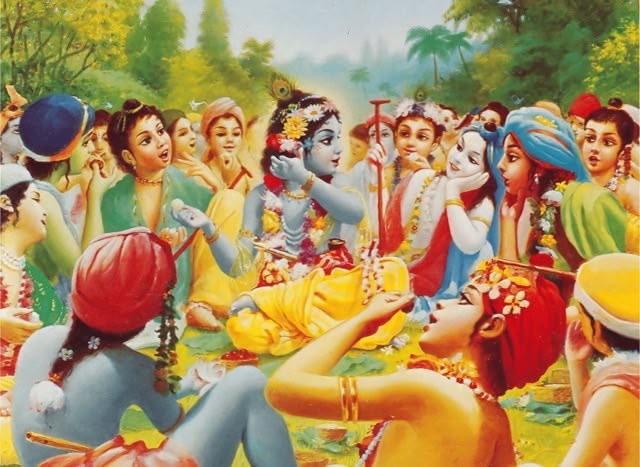
Remember that the real purpose of preparing and offering food to the Lord is to show your devotion and gratitude to Him. Krishna accepts your devotion, not the physical offering itself. God is completely self-sufficient—He needs nothing, but out of His immense mercy, He allows us to offer Him food so that we can develop our love for Him.
After offering the food to the Lord, wait at least five minutes for Him to eat. Then you should transfer the food from the special plates and wash them. Now you and all guests can eat the prasadam. While eating, try to appreciate the spiritual value of the food. Remember that because Krishna has accepted it, it is non-different from Him, and therefore by eating it you become purified.
Everything you offer on your altar becomes prasadam, the mercy of the Lord. Flowers, incense, water, food—everything you offer for the Lord's pleasure becomes spiritual. The Lord enters into the offerings, and thus the remnants are non-different from Him. So you should not only respect the things offered, but also share them with others. Distributing prasadam is an essential part of Deity worship.
Daily Life: Four Regulative Principles
Anyone serious about progressing in Krishna consciousness must try to avoid these four sinful activities:
Eating meat, fish, or eggs. These foods are saturated with the modes of passion and ignorance and therefore cannot be offered to the Lord. A person who eats these foods participates in a conspiracy of violence against helpless animals and thus stops his spiritual progress.
Gambling. Gambling always creates anxiety and fuels greed, envy, and anger.
Intoxication. Drugs, alcohol, and tobacco, as well as any drinks or foods containing caffeine, cloud the mind, overstimulate the senses, and make it impossible to understand or follow the principles of bhakti-yoga.
Illicit sex. This is sex for any purpose other than procreation with one's spouse according to the guidelines mentioned here. Sex for pleasure makes one identify with the body and takes one away from Krishna consciousness. The scriptures teach that sex is the most powerful force binding us to the material world. Anyone who wants to take Krishna consciousness seriously should give up sex completely or, if they want to raise children in Krishna consciousness, should engage in sexual intercourse only once a month for 4-6 days immediately after the wife's menstrual cycle and after the husband and wife have each chanted 50 rounds of the Hare Krishna mahamantra.
Engaging in Practical Devotional Service
"Work done as a sacrifice for Vishnu [Krishna] has to be performed; otherwise work causes bondage in this material world."
— Bhagavad-gita 3.9
Everyone must perform some kind of work, but if you work only for yourself, you must accept the karmic reactions of that work. You do not need to change your profession, unless you are currently doing sinful work (e.g., as a butcher or bartender).
Talents for Krishna
A programmer creates websites for the temple, a designer designs posters, a teacher teaches Vedic wisdom, a cook cooks prasadam.
Direct Service
You can also directly help the temple by dedicating your spare time and performing various services at the temple.

Donations
You should sacrifice some of the fruits of your work by donating a portion of your earnings to help maintain the temple and spread Krishna consciousness.
Community
Some devotees buy Hare Krishna literature and distribute it. There is also a wide network of devotees who gather in each other's homes. Contact your local temple.
Additional Principles of Devotion
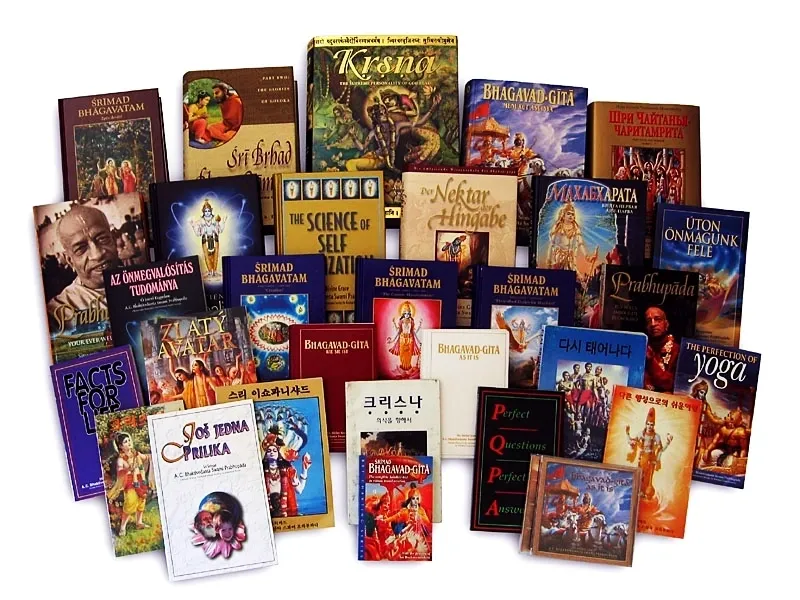
Studying Literature
ISKCON Founder-Acharya Srila Prabhupada spent much time writing books such as Srimad-Bhagavatam. Hearing the words of a self-realized spiritual master or reading scriptures is an essential spiritual practice.
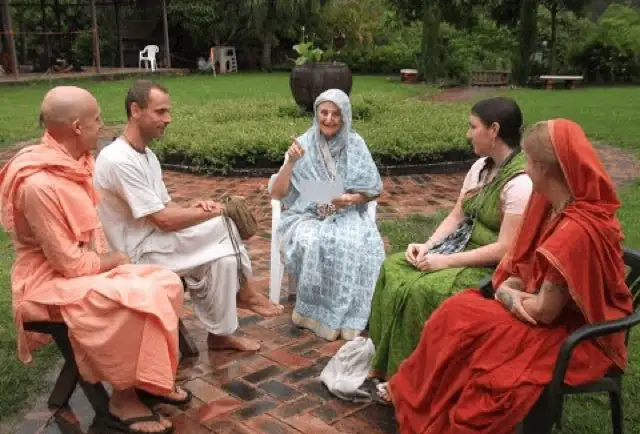
Association with Devotees
Srila Prabhupada established the Hare Krishna movement to give people the opportunity to associate with the Lord's devotees. This is the best way to gain faith in the process of Krishna consciousness.
Try to visit your nearest Hare Krishna center as often as possible.
Conclusion
The beauty of Krishna consciousness is that you can take as much as you are ready for. Krishna Himself says in the Bhagavad-gita (2.40):
"In this endeavor there is no loss or diminution, and a little advancement on this path can protect one from the most dangerous type of fear."
So include Krishna in your daily life and we guarantee you will feel the benefit.
Hare Krishna!